

Solving a Common Fence Problem in Osoyoos, BC: Building It the Right Way from th
At OK Vinyl Products, we get asked a lot of great questions — but one of the most common is this:
“Can you install a fence on top of a retaining wall?”
The short answer is yes — but the right answer depends on how it’s done.
Recently in Osoyoos, BC, we were brought in to solve a fence issue that perfectly illustrates why experience and problem-solving matter when it comes to fencing.
The Problem: Fences Installed on Retaining Walls Don’t Always Last
On this particular property, the fence looked fine at first glance. It was a relatively short fence — only about three feet tall — installed directly on top of a retaining wall built with Allan Block and capstones.
But here’s the issue most people don’t see:
Those capstones are typically held in place with construction adhesive (often PL Premium), not concrete footings.
Over time, constant forces like:
Wind pressure
Seasonal temperature changes
Natural ground movement
begin to work against that adhesive. Eventually, it gives way.
Once that happens, the fence no longer has a true footing — and at that point, the entire structure is essentially free to move… or worse, blow over completely.
Why This Is a Structural Issue — Not a Fence Height Issue
A common misconception is that shorter fences don’t need the same structural support as taller ones. In reality, any fence that lacks a proper footing is vulnerable, regardless of height.
When a fence is mounted directly to capstones:
There’s no post embedded in the ground
No concrete anchoring the structure
No long-term resistance to lateral movement
It might hold for a while — but it’s not a permanent solution.
The OK Vinyl Solution: Reinforced Posts Installed Behind the Retaining Wall
Rather than attempting a temporary fix, our team designed a long-term structural solution.
Here’s how we approached it:
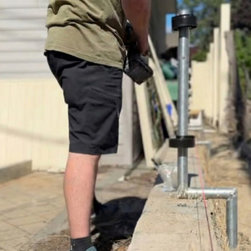
A reinforced post was installed behind the retaining wall
The post was concreted directly into the ground
The fence was aligned so the posts landed in the exact same visual position
The finished result looked clean, intentional, and seamless
From the outside, you’d never know the fence wasn’t simply mounted on the wall — but structurally, it’s now anchored where it matters most.
The Result: A Fence That Will Not Move
By relocating the structural support behind the wall and setting the posts properly in concrete, the fence now has:
A true footing
Long-term stability
Resistance to wind and movement
A clean, professional appearance
Most importantly, it’s a permanent fence solution, not a short-term workaround.
This is the difference between simply installing a fence — and engineering one to last.
Why This Matters for Homeowners in Osoyoos, BC
Osoyoos presents unique challenges when it comes to fencing:
“Can you install a fence on top of a retaining wall?”
The short answer is yes — but the right answer depends on how it’s done.
Recently in Osoyoos, BC, we were brought in to solve a fence issue that perfectly illustrates why experience and problem-solving matter when it comes to fencing.
The Problem: Fences Installed on Retaining Walls Don’t Always Last
On this particular property, the fence looked fine at first glance. It was a relatively short fence — only about three feet tall — installed directly on top of a retaining wall built with Allan Block and capstones.
But here’s the issue most people don’t see:
Those capstones are typically held in place with construction adhesive (often PL Premium), not concrete footings.
Over time, constant forces like:
begin to work against that adhesive. Eventually, it gives way.
Once that happens, the fence no longer has a true footing — and at that point, the entire structure is essentially free to move… or worse, blow over completely.
Why This Is a Structural Issue — Not a Fence Height Issue
A common misconception is that shorter fences don’t need the same structural support as taller ones. In reality, any fence that lacks a proper footing is vulnerable, regardless of height.
When a fence is mounted directly to capstones:
It might hold for a while — but it’s not a permanent solution.
The OK Vinyl Solution: Reinforced Posts Installed Behind the Retaining Wall
Rather than attempting a temporary fix, our team designed a long-term structural solution.
Here’s how we approached it:
From the outside, you’d never know the fence wasn’t simply mounted on the wall — but structurally, it’s now anchored where it matters most.
The Result: A Fence That Will Not Move
By relocating the structural support behind the wall and setting the posts properly in concrete, the fence now has:
Most importantly, it’s a permanent fence solution, not a short-term workaround.
This is the difference between simply installing a fence — and engineering one to last.
Why This Matters for Homeowners in Osoyoos, BC
Osoyoos presents unique challenges when it comes to fencing:
- Sloped properties
- Retaining walls
- Wind exposure
- Long, hot summers that stress materials
- We don’t just ask “Can it be done?”
- We ask “Will it last?”
That’s why cookie-cutter solutions don’t always work here.
At OK Vinyl Products, we specialize in identifying potential failure points before they become problems — and designing solutions that protect your investment for the long haul. Watch video of this unique problem solving process.
Problem-Solving Is Built Into Everything We Do
This project is a perfect example of how OK Vinyl approaches every job:
Whether you’re dealing with retaining walls, slopes, or challenging site conditions in Osoyoos or the surrounding South Okanagan, our team is equipped to design fencing solutions that are both beautiful and structurally sound.
If you’re planning a fence and aren’t sure how your property conditions will affect the installation, we’re always happy to talk through the options and help you do it right the first time.